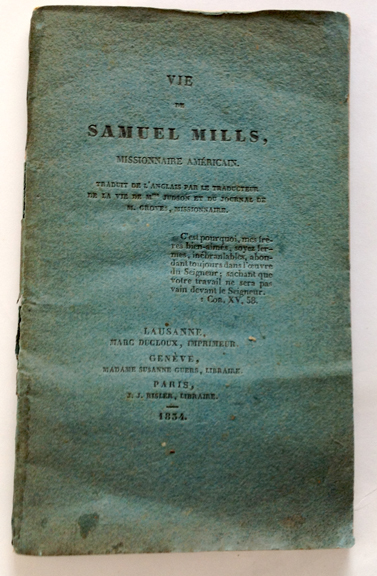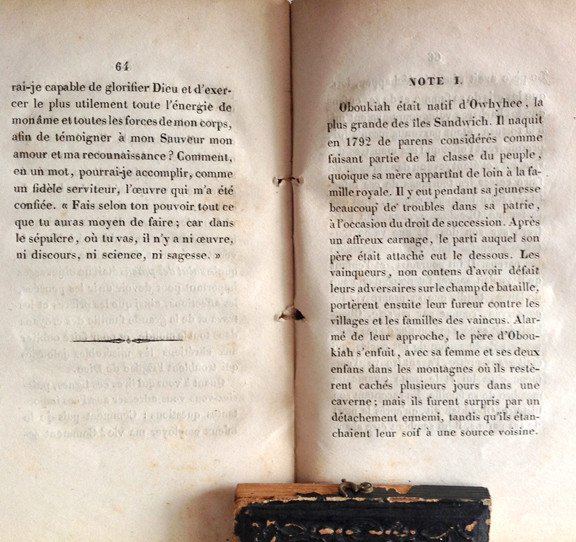
Vie de Mills Missionnaire Américain is a booklet published in 1834 out of Switzerland. The life of Samuel Mills Jr., the leader of the famed Haystack Meeting that launched American foreign missions, is told in the booklet. A brief life of Opukaha‘ia is appended to Mills’s life. There is an online version of Vie de Mills Missionnaire American. I was able to locate a copy of this rare and obscure publication out of the home of John Calvin in a book store located in Barcelona, Spain. The wonder of the World Wide Web! No new information is included in Vie de Mills Missionnaire American, but discovering the story of Obookiah in French shows additional evidence of how widespread the fame of Obookiah’s story was in the 19th century.
Hana Hou Tour coming to Big Island
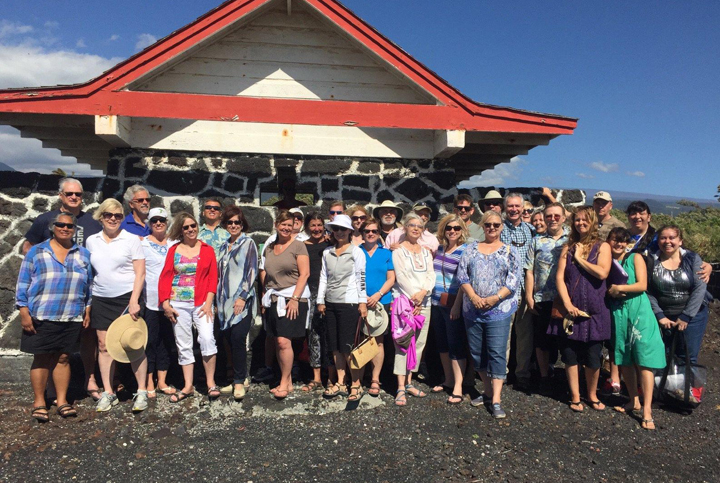
I am joining Dave Buehring’s Hana Hou Christian Heritage Tour on the Big Island from Saturday, February 13-16, 2016. I will be an interpretive guide for the visitors from the Mainland coming to Hawai‘i to visit key sites in the life of Opukaha‘ia. Opukaha‘ia’s descendant Deborah Lee, who led in the return of Henry’s remains in 1993, will also being serving as interpretive guide on the tour.
Local residents are invited to join the tour. Go to www.hanahou.info for more information. Those accompanying the tour are asked to share in covering the costs for the joint meals being provided.
The tour schedule includes a visit to Hikiau Heiau on the shore of Kealakekua Bay and Henry’s grave site at the Kahikolu (Trinity) Church on Saturday, February 13.
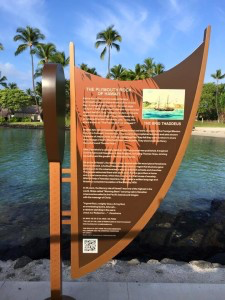
On Sunday, February 14 the tour moves to the Mokuaikaua Church, home of Hawai‘i’s oldest existing Protestant church, and a look at the Plymouth Rock of Hawai‘i sign at the Kona Pier. I helped write the text of the new sign, posted to mark the 195th anniversary of the Mokuaikaua Church. Will be interesting to see the historic signage in person.
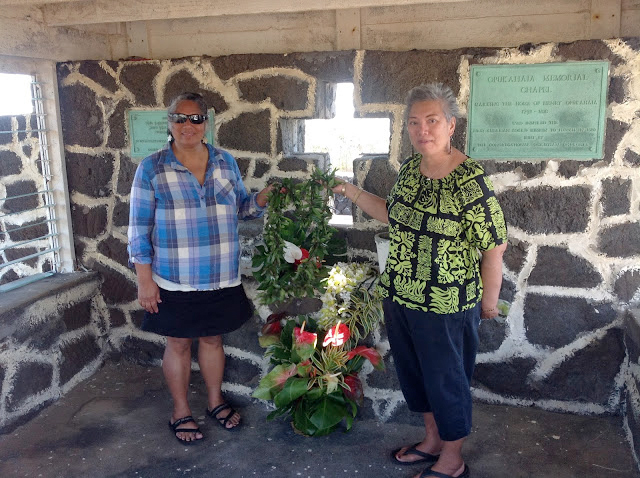
On Monday, February 15 we head to Punalu‘u Beach in Ka‘u to visit the chapel dedicated to Henry. His birthplace and childhood home were at Ninole, the land section on the south end of Punalu‘u Beach. Then the tour bus will travel north to Volcano National Park to revisit the site of early Native Hawaiian Christian and alibi Kapiolani’s defiance of the goddess Pele in the 1820s.
Tuesday, February 16 the tour ends at Haili Church in downtown Hilo. Here I will join Deborah Lee at her family’s home church when we join a panel discussion on the impact of the American Protestant Mission in Hawai‘i. The roots of the Haili Church go back to Hawai‘i’s Great Awakening in the late 1830s. The Rev. Titus Coan from Connecticut led the Sandwich Islands Mission station in those days. Native Hawaiian became Christians by the hundreds and thousands in the late 1830s, and the Hilo congregation grew to about 12,000; the church was declared to have the largest congregation in the entire Protestant world.
Hawai‘i’s First Christmas
I wrote about Hawai‘i’s first Christmas celebration in my book A Kaua‘i Reader published by Mutual Publishing. The Garden Island newspaper in Lihu‘e, Kaua‘i republished my article in 2000 and titled it “Homesick Sailors Celebrated Kauai’s First Christmas.”
Tahitian connection
In the chapter “Tahitian Connection” in my book The Providential Life & Heritage of Henry Obookiah I detail the influence of the Tahitian church in the coming of the Gospel to Hawai‘i as seen through the eyes of the America’s foreign mission movement led by the American Board of Commissioners for Foreign Missions.
As often happens when sending a book to print, new information soon after appears. Here are copies I have recently acquired of items published in contemporary missionary publications in the 1820s that tell of this Tahitian connection.

From the London Missionary Society’s Missionary Sketches, a pamphlet-size publication regularly distributed to supporting members of the London Missionary Society, from 1824. Here is the only known illustration of the work of Auna, the Tahitian missionary and teacher who arrived in Hawai‘i in 1822. Auna, a Tahitian ali‘i, opened a school in a large thatched hale located near Honolulu Harbor.
These comments appeared in late 1820 and early 1821 issues of the Religious Intelligencer, a weekly newsprint missionary and revival-focused publication from New Haven, published and edited by Nathan Whiting. One of the accounts came from the pages of the Boston Recorder, a prominent Christian newspaper in its day.
Below is another account from the Religious Intelligencer, written from the viewpoint of the New Haven publication in 1820.